
Data silos: are your teams really losing 5.5 hours a week searching for information?
Based on studies by the consulting firm FMI Corporation, the KPMG Global Construction Survey 2025/2026 and 2026 market analyses (Mordor Intelligence, Deloitte)
Quick answer
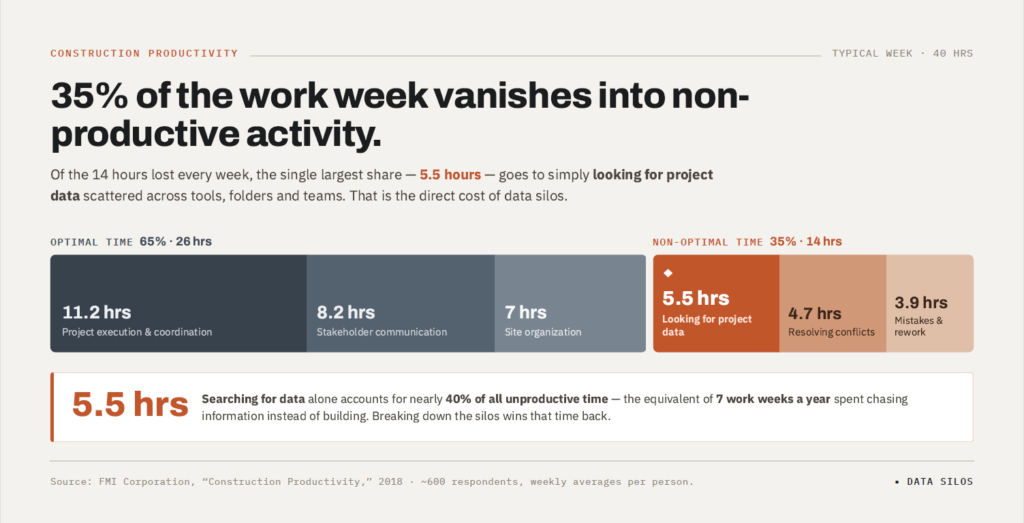
Most likely, yes. According to a study by the consulting firm FMI Corporation conducted in 2018 among some 600 construction professionals, teams spend 35% of their time on non-optimal activities, and searching for project data is the heaviest of them: 5.5 hours per week, per person, looking for information that already exists somewhere. In the United States alone, these non-optimal activities represented roughly US$177.5 billion in labour costs for the year of the study. The main cause: information scattered across systems that do not talk to each other. The average contractor juggles 11 separate applications, and only a third of them exchange data without manual handling.
Critical issue: in 2026, data silos no longer cost only time. They block access to artificial intelligence, which requires centralized and structured data to work. An AI plugged into silos produces incomplete answers; an AI built on a structured data architecture becomes a real lever for automation and decision-making.
Where do these 5.5 hours lost per week come from?
From the field, and the figure is hard to dispute.
The consulting firm FMI Corporation, which specializes in the construction industry, surveyed nearly 600 professionals in the sector about how they actually use their working time. The findings are striking:
- 35% of working time goes to “non-optimal” activities: searching for information, resolving conflicts, correcting errors and redoing work.
- Searching for project data is the biggest source of waste: 5.5 hours per week, per person, finding the right version of a plan, a supplier’s confirmed price, the status of an order, the history of a decision.
- Add to that roughly 4.7 hours managing conflicts between stakeholders and 3.9 hours dealing with errors and rework: in total, more than 14 hours a week go to non-productive activities.
- Poor communication between stakeholders is said to account for 26% of rework, a potential US$17 billion per year, and poor project information for 22% of rework, a further US$14.3 billion.
- The overall bill: roughly US$177.5 billion in labour costs for the year of the study, in the United States alone.
What this means for you: for a team of 10 people in the office and on the jobsite, 5.5 hours a week each is the equivalent of one full-time employee paid solely to look for information. A position no one has ever posted, but that almost every company funds.
Sources: Construction Dive, Industry could be overspending $177B per year | US Glass Magazine, Report: Time Spent on Non-Optimal Activities
What does bad data really cost?
US$1.8 trillion. In a single year. Worldwide.
That is the estimate from a large study conducted by FMI Corporation among more than 3,900 construction professionals around the world. “Bad” data (inaccurate, incomplete, inaccessible, inconsistent or late) is estimated to have cost the global construction industry US$1.8 trillion in 2020.
The study also quantifies more specific impacts:
| Finding | Figure | What it means |
| Rework attributable to bad data | US$88.7 billion per year | 14% of all rework carried out in the industry in 2020 |
| Respondents for whom more than half of project data is “bad” | More than 30% | One company in three decides blind half the time |
The key point: the problem is almost never a lack of data. Your bids, purchase orders, timesheets and jobsite reports generate data every day. The problem is that it lives in silos: an estimating software here, accounting there, Excel sheets all over the place, and text messages that leave no trace.
Sources: Construction Briefing, Bad data costing construction US$1.8 trillion | Construction Specifier, Survey estimates time and money lost to rework
How do data silos form in a construction company?
One software at a time, with the best intentions in the world.
The scenario is almost always the same. The company grows. The estimator adopts a bidding tool. Accounting chooses its own software. Project managers run their jobsites in a third system, or in Excel. CCQ payroll happens somewhere else. Each choice makes sense on its own. But ten years later, the picture is this:
- 11 separate applications on average at a contractor, according to Mordor Intelligence, and only a third exchange data without manual handling.
- Having custom connections built between systems costs roughly US$50,000 per connection, an amount most SMEs cannot justify.
- According to the KPMG Global Construction Survey 2025/2026, 76% of engineering, construction and real estate executives consider technology critical to their strategic priorities, and 53% worry about their organization’s ability to adapt at the required speed.
Result: the same information is entered two, three, sometimes four times. Each re-entry is an opportunity for error, and each system becomes a different version of the “truth”.
What this means for you: if your estimator, your accountant and your project manager give three different answers to “what is our margin on this project?”, you do not have a staffing problem. You have a silo problem.
Sources: Mordor Intelligence, Construction Management Software Market | KPMG, Global Construction Survey 2025/2026
What are the concrete symptoms in your company?
Here are the five most common signals. If you recognize three of them, silos are already costing you dearly:
- The information hunt: knowing the status of an order requires a call to the office, a search through emails and a check with the supplier.
- Double data entry: the same bid data is retyped into the sales order, then into purchasing, then into invoicing.
- Conflicting versions: the jobsite works from one version of the file, the office from another, and no one knows which is right.
- Margins discovered at the end: a project’s true profitability is only known when the file closes, when it is too late to adjust.
- Dependence on individuals: critical information lives in the head (or inbox) of one or two key people. When they are away, everything slows down.
In Quebec, this waste comes at the worst possible time. After a record year of 216 million hours worked in 2025, the CCQ still forecasts 213.3 million hours in 2026 and points out that the industry will need more workers to build the Quebec of tomorrow. When labour is scarce and expensive, every hour spent searching for information instead of building is an hour no one can replace.
Source: CCQ, Perspectives 2026
Why is 2026 the tipping point?
Because silos no longer cost only time: they now block access to artificial intelligence.
The KPMG Global Construction Survey 2025/2026, which gathers the views of 375 engineering, construction and real estate executives, ranks data analytics and generative AI among the technologies set to transform the sector. Investment is following: companies devote nearly 18% of their transformation spending to technology and data, second only to labour. The same survey, however, reveals the real obstacle: most companies have accumulated a collection of digital tools, but these investments only deliver value if they rest on solid data foundations and integrated systems, from design to purchasing, then to the jobsite and delivery.
This is exactly the silo problem. An AI plugged into fragmented data produces incomplete or wrong answers. Executives have understood it: the issue is no longer adopting isolated tools, but making data flow in real time to anticipate rather than find out after the fact.
What does being “AI-ready” mean?
Many software vendors today add a layer of AI on top of existing systems. The result is often disappointing, for a simple reason: AI cannot reason over data it cannot see, or that contradicts itself from one system to another. Before even talking about algorithms, three conditions must be met:
- Centralized data: all of the company’s information (bids, purchasing, inventory, jobsite, payroll) lives in a single environment.
- Structured data: each product, each project, each transaction has defined and consistent attributes that a machine can use.
- Connected workflows: AI can not only analyze but support action, because the processes are linked together.
This is the bet Atoom ERP has made since its design: its database is structured from the outset to facilitate the learning and training of artificial intelligence models. Concretely, Atoom’s integrated AI learns from the company’s daily operations to anticipate needs, recommend actions and reduce delays at every stage of the project cycle. Clients do not have to spend weeks cleaning and reorganizing their data before turning on AI: it learns directly from the system’s real data. And because all modules share the same database, every piece of information entered enriches the whole system rather than adding one more silo.
What this means: centralizing your data is no longer only an efficiency project. It is the entry ticket to the next technological decade. Companies that break down silos now are getting ready to benefit from AI; the others will first have to fix their silo problem, then make up for lost time.
Sources: KPMG, Global Construction Survey 2025/2026 | Deloitte, State of Digital Adoption in the Construction Industry 2026
Is your project information scattered across 11 systems? Discover how Atoom ERP, with its integrated artificial intelligence, centralizes bids, purchasing, jobsite and payroll in a single platform built for Quebec construction.
Adding specialized software or centralizing: how to decide?
The question deserves a real comparison, because both approaches exist for good reasons.
| Criterion | Multiple specialized software | Integrated platform (construction ERP) |
| Functional depth per department | Excellent, each tool is sharp | Very good, designed to cover the whole cycle |
| Information flow | Depends on costly, fragile integrations | Native: data entered once flows everywhere |
| Number of versions of the “truth” | One per system | A single one |
| Real cost | Multiple licenses + integrations (about US$50,000 per connection) + re-entry time | One platform, one vendor |
| Real-time profitability view | Rebuilt manually, often at project end | Continuous, from CRM to invoicing |
| AI value | Limited: each tool has its own AI, blind to the rest | High: an AI that sees the whole cycle, from bid to delivery |
| AI readiness | Difficult: fragmented data to clean first | Natural: data already centralized and structured |
This is exactly Atoom ERP‘s approach: a single platform where the opportunity won in the CRM creates the project, where the bid feeds the projection of purchasing needs, where inventory quantities are visible when preparing a requisition, and where profitability is tracked continuously rather than discovered at file closing. From project management, you see which purchases relate to which task and where they stand: the information hunt between jobsite and office disappears.
And because all this data lives in one place, structured from the moment of entry, Atoom’s integrated artificial intelligence can deliver its value: more accurate estimates thanks to project history and centralized price databases, prioritization of contracts by their potential profitability, and a system that learns from operations to anticipate needs and recommend actions. More than a management software, it is a platform that automates transactions and supports decisions from your data.
Where to start to break down your data silos in construction ?
No need to change everything at once. Here is a realistic four-step approach:
- Map your systems: list every software, Excel file and paper process where project data lives. Most companies discover more than they thought.
- Measure double entry: identify the information retyped more than once. Each re-entry is a recurring cost and a risk of error.
- Identify your source of truth: for each critical data point (margins, costs, schedules), determine which system prevails. If there is no clear answer, that is where breaking down silos must begin.
- Prioritize the bid-purchasing-project flow: this is where silos cost the most in construction, because this is where margins are won or lost.
Conclusion: the essentials at a glance
According to the consulting firm FMI Corporation, construction professionals spend 5.5 hours a week searching for project data, and 35% of their time on non-optimal activities, a bill estimated at roughly US$177.5 billion per year in the United States at the time of the study. Bad data cost the global industry US$1.8 trillion in a single year. The cause: stacks of 11 disconnected software on average, where the same information is re-entered several times and no one shares the same version of the truth. In 2026, the issue has changed in nature: AI requires centralized and structured data, and silos have become the main obstacle between your company and the next technological decade. Breaking down data silos goes from “good idea” to a condition of competitiveness.
Ready to reclaim your lost hours and put AI to work? Discover the Atoom ERP solutions, the platform with integrated artificial intelligence that connects CRM, bids, purchasing, jobsite and payroll on a database structured from the design stage for AI model learning.
Sources
-
Construction Dive, Industry could be overspending $177B per year, study finds (2018)
-
US Glass Magazine, Report: Time Spent on Non-Optimal Activities Costs the Construction Industry Billions Annually (2018)
-
Construction Briefing, Bad data costing construction US$1.8 trillion
-
Construction Specifier, Survey estimates time and money lost to rework and miscommunication
-
KPMG, Global Construction Survey 2025/2026
-
Mordor Intelligence, Construction Management Software Market, 2026
-
CCQ, Perspectives 2026
-
Deloitte, State of Digital Adoption in the Construction Industry 2026