

Why construction productivity has become an absolute emergency
In August 2024, McKinsey & Company published a particularly insightful article titled Delivering on construction productivity is no longer optional. It paints a rigorous, data-driven picture of the productivity gap affecting the global construction industry, and highlights why this lag, long tolerated, has become an urgent problem in the face of the energy transition’s ambitions. This article draws out its most important points, and what they mean concretely for construction companies here at home.
In short: Global construction productivity grew by only 0.4% per year between 2000 and 2022, five times less than the manufacturing sector and four times less than the global economy as a whole. Yet the sector is called upon to deliver the global energy transition by 2050. Closing this gap is no longer an option: it is a condition of survival for companies and a necessity for the environment.
See also: ATOOM ERP solutions for construction | About ATOOM ERP
Is construction really suffering from a productivity crisis?
Yes. And the finding has been documented for decades.
In a study published in August 2024, McKinsey & Company paints an unambiguous picture: economic productivity in construction (value added per hour worked) grew by only 0.4% per year between 2000 and 2022. For comparison, the global economy as a whole grew by 2% per year over the same period, and the manufacturing sector by 3%. Between 2020 and 2022, productivity in global construction actually declined by 8%.
This is not a cyclical problem. It is a structural, chronic problem, documented for at least twenty years.
Why does this lag persist?
Several factors explain this stagnation:
- Underinvestment in technology: historically, construction companies devote less than 1% of their revenue to information technology, roughly three times less than the automotive or aerospace sectors.
- Fragmented operations: most jobsites still run on email exchanges, Excel spreadsheets and non-integrated manual processes. Effective jobsite management today requires far more than that.
- Siloed data: project, purchasing, accounting and workforce information often remains in separate systems that do not communicate with one another.
- Inherent complexity: every project is different, every jobsite has its own constraints, which makes large-scale standardization difficult.
Source: McKinsey & Company. “Delivering on construction productivity is no longer optional.” August 2024. Read the article
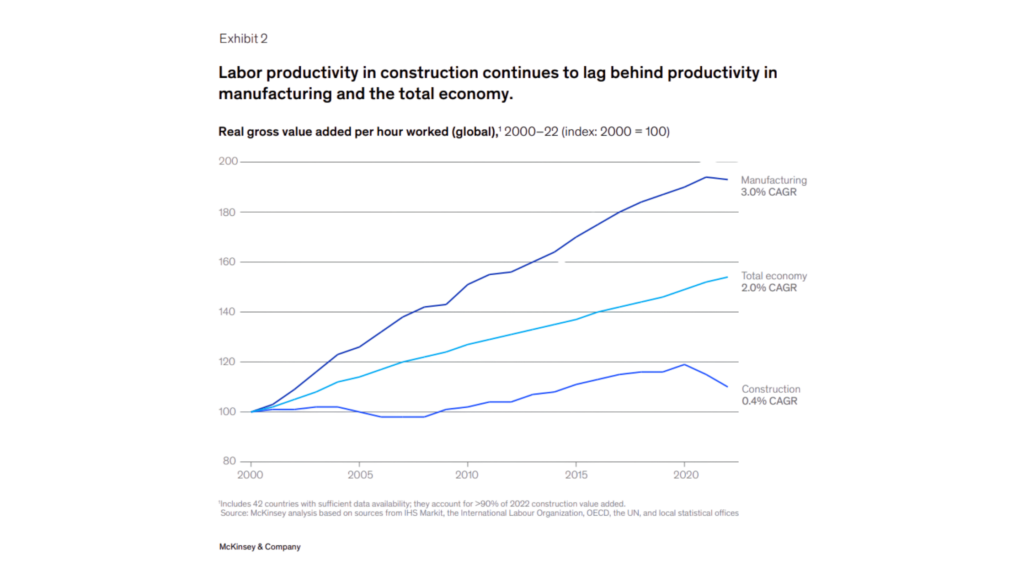
This chart shows the 2000-2022 productivity index for construction (0.4% CAGR), the total economy (2.0% CAGR) and manufacturing (3.0% CAGR).
What role must construction play in reaching carbon neutrality by 2050?
A central role. And a more important one than many imagine.
Construction is not just one economic sector among others. It is the sector that will have to concretely deliver the vast majority of projects tied to the global energy transition:
- Developing and deploying wind, solar and hydroelectric farms
- Renovating and insulating millions of residential and commercial buildings
- Building low-carbon transport infrastructure (rail, subway, charging stations, bike paths)
- Delivering the affordable housing, hospitals and schools that growing populations require
McKinsey projects that global construction spending will rise from US$13 trillion in 2023 to US$22 trillion in 2040. To meet this, construction companies outside China will need to double their growth rate, from roughly 1.3% to 2.7% compound annual growth.
Tension is real: the industry must deliver more projects, faster, with a shrinking workforce, while reducing its own environmental impact.
In summary: The construction industry is both responsible for delivering the energy transition and, in its current form, insufficiently productive to do so at the required pace.
Data drawn from McKinsey Exhibit 1, page 2 of the report: “Construction is already one of the largest industries, but its growth rate (excluding China) would need to double to meet 2040 demand.”
Why has the urgency intensified today?
The workforce is retiring at an unprecedented pace
In the United States, nearly 41% of the workforce present in construction before 2020 is expected to retire by 2031. In the United Kingdom, the sector could lose a quarter of its workers over the next 15 years due to retirements. In Quebec, the shortage of skilled labor is one of the industry’s most pressing challenges. These massive departures take with them decades of field expertise that cannot be replaced by new hires alone.
Demand for infrastructure is not slowing down
Climate targets are generating an unprecedented order book. At the same time, population growth continues to create needs for housing, healthcare facilities and schools that the sector already struggles to absorb at its current pace.
The pressure on margins is real
With rising costs for materials, energy and labor, every poorly managed project costs more than before. Ordering errors, budget overruns and stretched-out billing timelines are no longer tolerable inconveniences: they directly threaten companies’ viability.
The number to remember: According to McKinsey, if the sector stays on its current trajectory, the cumulative gap between demand and supply could reach US$40 trillion by 2040 (excluding China). Conversely, a productivity improvement of 1% per year above the current trend would be enough to close this gap.
Data drawn from McKinsey Exhibit 5, page 8 of the report: “On the current trajectory, construction output might fall short of demand by $40 trillion by 2040.”
What are the main structural barriers to construction productivity?
McKinsey identifies seven barriers to productivity in this sector. Here are the ones most directly addressable for mid-sized companies, and what a construction-specific ERP like ATOOM ERP can concretely change:
| Structural barrier | Concrete impact | What an ERP can change |
|---|---|---|
| Underinvestment in technology | Manual processes, repeated errors | Integrated platform, mobile access |
| Fragmented data | Poor decisions, delays | Real-time centralization |
| Complex project management | Budget and schedule overruns | Project management module with alerts |
| Non-optimized purchasing | Material cost overruns, stockouts | Purchase orders, jobsite requisitions |
| Manual HR management | High administrative time | Timesheets, worker allocation |
| Separate construction accounting | Long reconciliation, errors | Accounting integrated with operations |
| Untracked inventory | Losses, stockouts, over-purchasing | Real-time stock management |

Can technology really make a difference in construction?
Yes, but on one condition: the solution must be designed specifically for construction from the ground up, and not adapted from a generic platform.
This is one of the most important distinctions to make when choosing a jobsite management tool. A generic platform forces the construction company to adapt to software designed for other realities: retail, professional services, distribution. An ERP built for construction builds in the sector’s particularities from the start.
What this means concretely:
- Native holdbacks and notices of claim/releases in the construction accounting module
- CCQ reports and management of competency certificates directly in the tool
- Management of extras and jobsite directives in a single system
- 100% mobile for field teams, not just for the office
The benefits of integrated construction project management are measurable:
- Fewer data-entry errors and omissions when placing orders
- Real-time visibility into costs per project, at any time
- Centralized purchasing with direct jobsite requisitions
- Automation of timesheets and CNESST reports
- Shorter time between the end of a jobsite and final billing
Where to start in modernizing the management of your construction company?
Step 1: Identify your most costly friction points
Identify the two or three processes that consume the most time and generate the most errors. Is it manual bids? Month-end accounting reconciliation? Tracking supplier orders in Excel? In other words: start by putting out the most costly fires, where errors and delays hurt the most day to day.
Step 2: Structure your data so it works for you
Digital transformation does not start with automation, it starts with the quality and structure of your data. Data siloed in Excel files, emails and separate systems can neither be automated effectively nor serve as a foundation for artificial intelligence.
This is where ATOOM ERP’s architecture makes the difference: the platform is designed with a data structure built for AI from the outset. Your operations generate structured, usable data, which makes it easier to activate artificial intelligence across your business.
Step 3: Prioritize mobile from the start
Your field teams do not work behind a desk. Software accessible only on a fixed workstation will never be adopted on the jobsite. Mobility is not a bonus: it is a condition for real adoption.
Step 4: Choose a tool designed for your industry
The specifics of construction in Quebec (CCQ, CNESST, holdbacks, notices of claim) cannot be improvised in a generic platform. They must be native to the chosen solution. That is what ATOOM ERP offers.
Step 5: Measure from the outset
Define two or three key indicators before deployment: monthly close time, purchase-order processing time, time between jobsite completion and invoice issuance. These metrics make it possible to demonstrate return on investment and to guide adjustments.
Schedule an ATOOM ERP demo
ATOOM ERP is a 100% mobile software, with built-in artificial intelligence, designed specifically for the construction vertical. It centralizes construction accounting, project management, purchasing, inventory management, sales and estimating, manufacturing and installation in a single platform.
ATOOM ERP supports general contractors, specialized contractors, manufacturers, distributors and developers in their digital transformation, thanks to a platform built for the realities of construction.
Learn more about our modules: Project management | Construction accounting | Purchasing and inventory
Conclusion: the key takeaways at a glance (TL;DR)
- Construction productivity has grown by only 0.4%/year since 2000, versus 2% for the global economy and 3% for manufacturing. Between 2020 and 2022, it actually declined by 8%.
- The sector must double its growth pace outside China (from 1.3% to 2.7% CAGR) to deliver projects tied to the energy transition by 2040.
- Global construction spending will rise from US$13 trillion to US$22 trillion by 2040.
- On the current trajectory, the gap between supply and demand could reach US$40 trillion by 2040 (excluding China).
- Underinvestment in technology (less than 1% of revenue on IT) is one of the structural factors behind the lag.
- Construction-specific ERPs make it possible to centralize, automate and improve visibility across projects, provided they are designed for the realities of the sector.
- The key: choose a mobile tool, native to construction, whose data architecture is built for AI from the outset.
Sources
- McKinsey & Company. Delivering on construction productivity is no longer optional. August 2024. mckinsey.com
- McKinsey & Company. Reinventing construction through a productivity revolution. February 2017.
Related articles